Filed under Rethink Society | Art History · 07 · Evidence
Photography When Reality Learned to Leave a Trace
The camera transformed memory and evidence while proving that mechanical images still require interpretation.
- Share “Photography — When Reality Learned to Leave a Trace” on X
- Share “Photography — When Reality Learned to Leave a Trace” on Facebook
- Share “Photography — When Reality Learned to Leave a Trace” on LinkedIn
- Share “Photography — When Reality Learned to Leave a Trace” on WhatsApp
- Share “Photography — When Reality Learned to Leave a Trace” on Telegram
- Share “Photography — When Reality Learned to Leave a Trace” on Reddit
- Share “Photography — When Reality Learned to Leave a Trace” on Email
Europe and global development · Early 19th century onwards
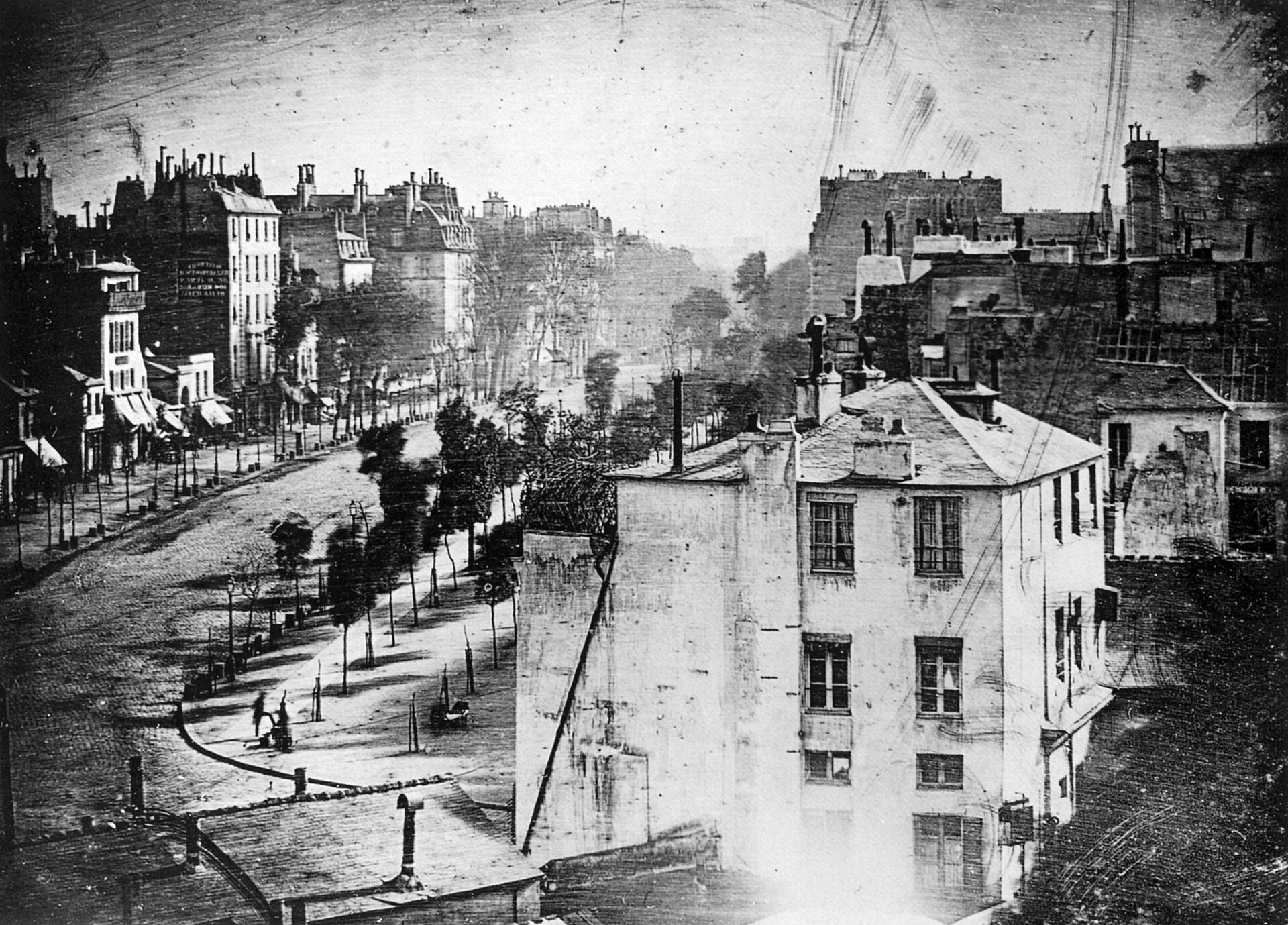
Photography changed the relationship between reality and memory. Before photographic processes became practical, images could record people and places, but every representation depended visibly on a maker's hand. The camera introduced a different kind of claim: light itself could leave a trace through a technical process. This did not eliminate interpretation, but it gave images unprecedented authority.
The Getty Museum notes that the essential components of photography were developed through the early nineteenth-century experiments of figures including Nicéphore Niépce, Louis-Jacques-Mandé Daguerre and William Henry Fox Talbot. Getty also describes photography's long connection with time: inventors sought ways to fix fleeting moments, while viewers praised photographs for recording what the unaided eye could not preserve.
This ability had enormous consequences. Photography documented families, cities, scientific phenomena and political events. It made visual records more widely reproducible and eventually more accessible. Ordinary people could increasingly possess images of themselves and their loved ones. Memory became material in a new way.
But photography never became a neutral witness. A photographer chooses where to stand, when to expose, what to include and what to exclude. Images can be staged, cropped, captioned and circulated in misleading contexts. Later digital technologies expanded manipulation further, but the basic problem existed from the beginning: mechanical production does not guarantee truthful interpretation.
This is why photography helped humanity in two apparently contradictory ways. It created powerful evidence while teaching us to ask what evidence means. A photograph can establish that something was in front of a camera at a particular moment under particular conditions. It cannot automatically explain motives, causes or the full context.
Photography also transformed art. If a machine could reproduce visible appearance, painters and other artists were increasingly free—or pressured—to reconsider what art should do. Modern artistic movements did not arise from photography alone, but the medium changed the visual ecosystem in which they developed.
The social impact was equally profound. Photography created archives, identities and surveillance systems. The same technology that preserves family memory can enable state monitoring. The same portrait that gives visibility can categorise and control. Technology rarely arrives with one moral meaning; institutions decide how capabilities are used.
In the age of AI-generated imagery, photography's history has become newly urgent. Many people once treated photographs as self-evident proof. Today, synthetic images make verification more difficult. The response should not be to conclude that nothing can be trusted. It should be to improve the methods by which images are checked: provenance, corroboration, metadata, context and independent evidence.
Photography therefore remains one of art history's greatest lessons in epistemology. Seeing is powerful, but seeing is not the end of knowing. The camera preserved reality's appearance. Humanity still has to do the harder work of understanding what it sees.
What We Know
The article's factual foundation is limited to the documented historical and institutional evidence identified in the source notes below. Claims of motive, universal meaning or direct causal impact are treated cautiously unless supported by evidence.
What Remains Open to Interpretation
Artistic meaning is often plural. Where original makers did not leave unambiguous explanations, this collection does not present modern interpretation as fact. Scholarly disagreement and uncertainty are part of the historical record, not editorial weaknesses.
Social Rethink
Can an image be completely authentic and still give us a false understanding of reality?
Why It Matters Now
This historical development remains relevant because contemporary society still debates who controls memory, whose stories are preserved, what counts as truth, how cultures influence one another and whether technology changes the meaning of human creativity. The historical case does not automatically provide a modern answer; it gives us better questions.
The Question We Leave Behind
Can an image be completely authentic and still give us a false understanding of reality?