Filed under Rethink Society | Art History · 01 · Memory
Prehistoric Cave Art When Humanity Began Leaving Messages for the Future
The first surviving images remind us that the human need to remember and imagine is older than civilisation.
- Share “Prehistoric Cave Art — When Humanity Began Leaving Messages for the Future” on X
- Share “Prehistoric Cave Art — When Humanity Began Leaving Messages for the Future” on Facebook
- Share “Prehistoric Cave Art — When Humanity Began Leaving Messages for the Future” on LinkedIn
- Share “Prehistoric Cave Art — When Humanity Began Leaving Messages for the Future” on WhatsApp
- Share “Prehistoric Cave Art — When Humanity Began Leaving Messages for the Future” on Telegram
- Share “Prehistoric Cave Art — When Humanity Began Leaving Messages for the Future” on Reddit
- Share “Prehistoric Cave Art — When Humanity Began Leaving Messages for the Future” on Email
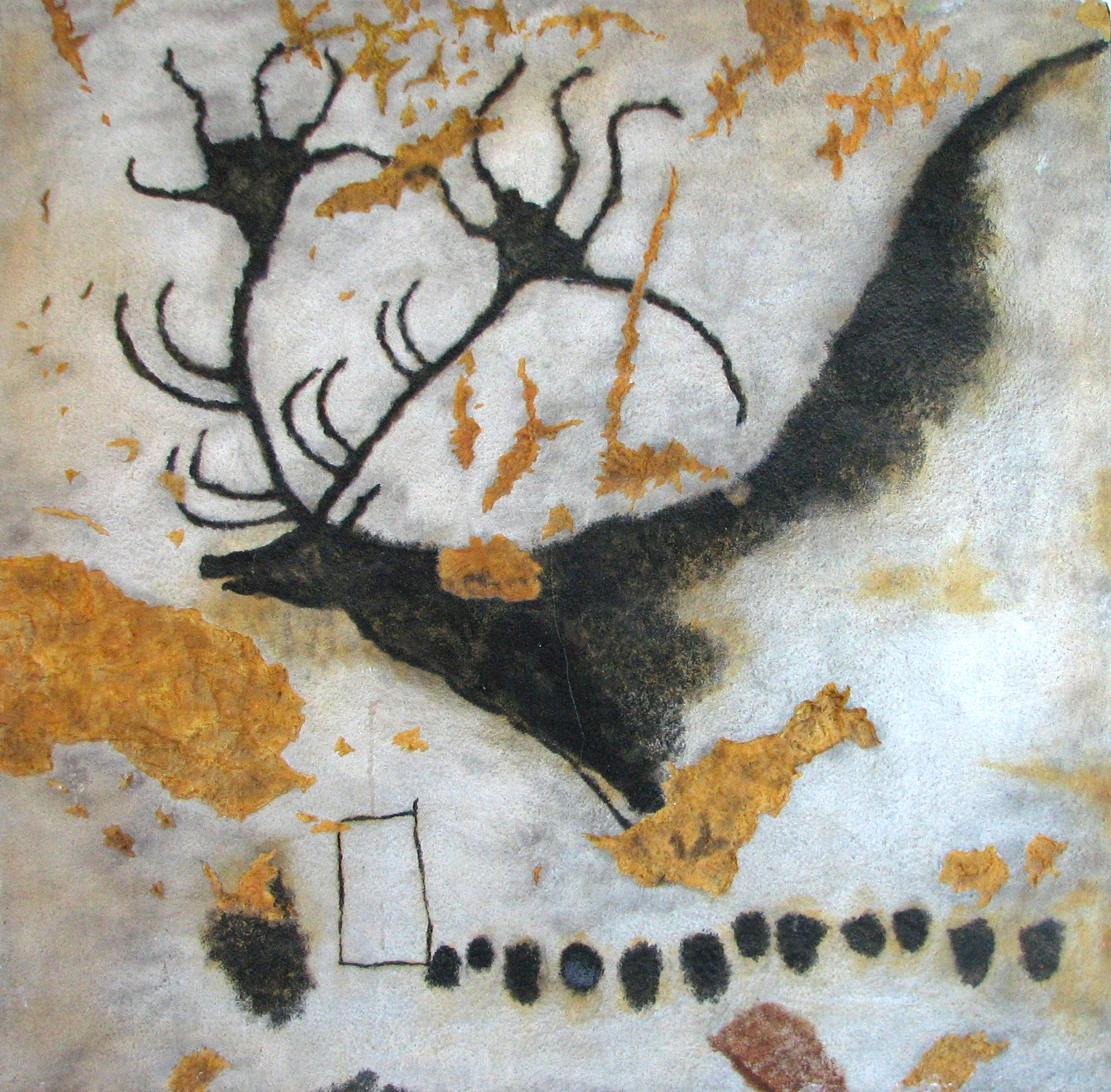
Indonesia, Europe, Africa and other regions • Prehistory · At least 45,500 years ago for one of the earliest securely dated figurative paintings currently known
What did the first artists believe they were doing? The honest answer is that we do not know. Yet prehistoric cave and rock art gives us something extraordinary: direct visual traces made by people who lived tens of thousands of years before writing. Hand stencils, animals, abstract signs and narrative-looking scenes survive in different regions of the world. They do not allow us to read prehistoric minds with certainty, but they prove that early humans and their relatives were capable of making marks that endured beyond the moment in which they were made.
One of the strongest recent reminders that the history of art is global rather than exclusively European comes from Sulawesi, Indonesia. Scientific dating of mineral deposits associated with a figurative painting of a Sulawesi warty pig at Leang Tedongnge produced a minimum age of 45,500 years. Researchers described it as the earliest known representational work of art at the time of publication. The crucial word is known: archaeology is an unfinished record, and new discoveries or improved dating methods can change the chronology.
That uncertainty matters because cave art is often surrounded by seductive stories. It is tempting to call a painting a hunting lesson, a religious ritual, a map, a myth or the beginning of cinema. Some interpretations may be plausible, but few can be proved from the image alone. Archaeologists combine dating, location, superimposition, pigments and comparison, yet the original voices of the artists are usually unavailable. Rethink Society therefore treats meaning as a question rather than an invented answer.
What can be stated with greater confidence is that these images are evidence of cultural activity. Someone selected a surface, used a technique, created an image and left a material trace that later humans could encounter. In that sense, prehistoric art changed the relationship between experience and time. A moment no longer had to disappear completely when the people who witnessed it died. A mark could remain.
Art also complicates simplistic ideas about our ancestors. Prehistoric people were not waiting passively for civilisation to make them imaginative. The surviving record shows technical knowledge of materials and repeated symbolic practices across very long periods. Different regions developed their own artistic traditions. The lesson is not that every ancient image means the same thing, but that the human impulse to represent, remember and communicate has deep roots.
Why does this help us today? Archaeology gives modern people a humbling form of evidence. We live in an age of photographs, cloud storage and constant communication, yet much of what we produce may disappear. A handprint on stone can survive longer than a digital platform. The first artists therefore force a contemporary question: what do we create because it matters now, and what do we create because we hope someone else will one day understand that we were here?
Perhaps art's first social contribution was not beauty in the modern museum sense. Perhaps it was continuity. A person could leave something behind for people they would never meet. That possibility still defines culture. We inherit songs, buildings, images and stories from strangers who are gone, then decide what they mean for us. Prehistoric art cannot tell us exactly why humanity began making images. It can tell us that long before modern states and written histories, humans were already capable of making the present speak to the future.
What We Know
The article's factual foundation is limited to the documented historical and institutional evidence identified in the source notes below. Claims of motive, universal meaning or direct causal impact are treated cautiously unless supported by evidence.
What Remains Open to Interpretation
Artistic meaning is often plural. Where original makers did not leave unambiguous explanations, this collection does not present modern interpretation as fact. Scholarly disagreement and uncertainty are part of the historical record, not editorial weaknesses.
Social Rethink
What if art's earliest achievement was not decoration, but the creation of a bridge across time?
Why It Matters Now
This historical development remains relevant because contemporary society still debates who controls memory, whose stories are preserved, what counts as truth, how cultures influence one another and whether technology changes the meaning of human creativity. The historical case does not automatically provide a modern answer; it gives us better questions.
The Question We Leave Behind
What if art's earliest achievement was not decoration, but the creation of a bridge across time?