Filed under Rethink Society | Cultural Revolutions · 07 · Industry
The Industrial Revolution: When Progress Changed the Meaning of
Industrialisation created modern wealth and modern inequality. What should progress mean in the age of AI?
- Share “The Industrial Revolution: When Progress Changed the Meaning of” on X
- Share “The Industrial Revolution: When Progress Changed the Meaning of” on Facebook
- Share “The Industrial Revolution: When Progress Changed the Meaning of” on LinkedIn
- Share “The Industrial Revolution: When Progress Changed the Meaning of” on WhatsApp
- Share “The Industrial Revolution: When Progress Changed the Meaning of” on Telegram
- Share “The Industrial Revolution: When Progress Changed the Meaning of” on Reddit
- Share “The Industrial Revolution: When Progress Changed the Meaning of” on Email
Human Life
RETHINK SOCIETY | CULTURAL REVOLUTIONS COLLECTION
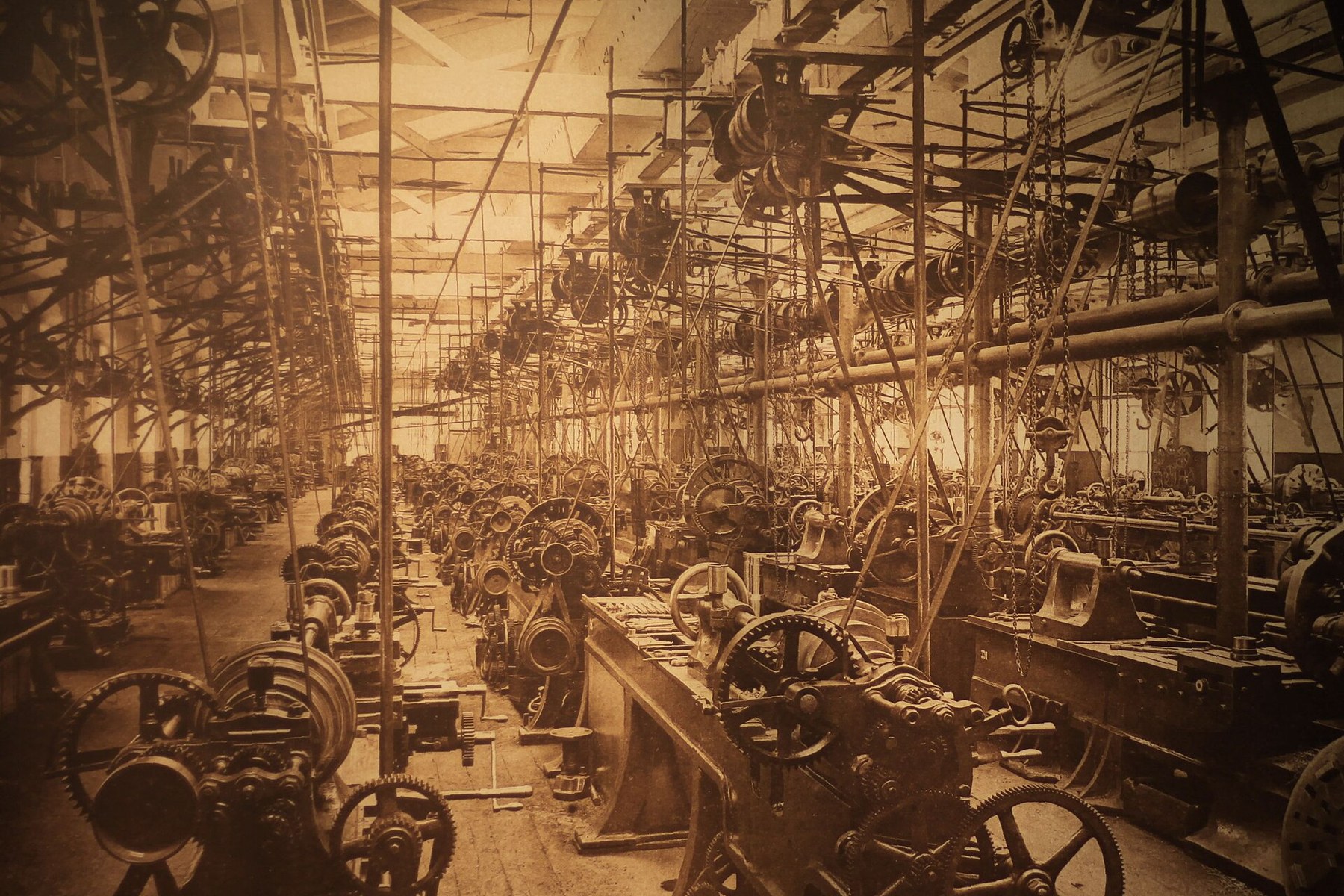
The Industrial Revolution changed society so thoroughly that many of its consequences still structure everyday life. Beginning in Britain in the eighteenth century and spreading unevenly across the world, industrialisation transformed production, transport, cities and work. It was not a single invention but a long process involving machines, fossil fuels, factories, finance, empire and global trade.
For many people, the most immediate change was work. Production increasingly moved from homes and small workshops into factories. Time became disciplined by clocks, shifts and supervisors. Workers sold labour in rapidly expanding industrial economies. Some experienced new opportunities; others faced dangerous conditions, low wages and insecurity. Industrial society created wealth on an unprecedented scale while also making inequality highly visible.
Cities expanded rapidly. Urban life brought universities, newspapers, theatres and political movements into dense proximity. It also brought overcrowding, disease and pollution. The modern city became a laboratory of progress and a warning about its costs. Governments gradually developed public sanitation, labour regulation and welfare institutions partly because industrial problems could no longer be ignored.
Industrialisation changed family life and gender roles, although not in one universal direction. Wage labour could separate workplaces from homes. Women and children worked in many industries, while middle-class ideals increasingly promoted domestic roles for women in some societies. These patterns varied across class and region. What mattered culturally was that industrial society turned everyday life into a subject of political and economic debate.
The Industrial Revolution also helped create organised labour. Workers recognised that individual bargaining was weak against large employers. Trade unions and political movements demanded safer workplaces, shorter hours and representation. The modern language of workers' rights emerged from conflicts over what industrial progress should mean.
Technology became associated with the future. New machines promised that human beings could overcome limits of distance and production. Railways compressed geography. Telegraph networks accelerated communication. Later electricity and mass manufacturing reshaped domestic life. But each innovation also created anxiety. Would machines replace workers? Would cities destroy communities? Would economic growth exhaust natural resources?
These questions now feel familiar because they never disappeared. Automation and artificial intelligence are contemporary versions of an old dilemma. Technology can increase productivity while redistributing insecurity. The benefits do not automatically reach everyone. Industrial history demonstrates that societies often need political choices—not technological optimism alone—to determine how innovation affects ordinary people.
The environmental legacy is equally important. Coal-powered industrialisation contributed to the large-scale fossil-fuel economy that now drives climate change. The historical idea of progress often assumed that greater production was inherently beneficial. Today humanity is forced to ask whether growth can continue without destroying the ecological conditions on which society depends.
Social Rethink
Progress should not be measured only by what humanity can produce. It should also be measured by how people live. Do workers have dignity? Are communities healthy? Is the environment protected? Who benefits from productivity? The Industrial Revolution shows that a society can become technologically advanced while remaining socially unjust.
Mass culture also emerged from industrial conditions. Urban populations created audiences for newspapers, popular entertainment and commercial products. Advertising and consumer identity expanded. People increasingly defined themselves not only by occupation or local community but by what they read, watched and bought.
The Industrial Revolution therefore made humanity rethink the meaning of modernity. It proved that technology could rapidly reorganise life. It also proved that societies could not simply allow technological change to govern itself.
Today, as AI and automation accelerate, the nineteenth century offers a warning and an opportunity. The future of work is not determined solely by machines. It will be shaped by laws, ownership, education and collective decisions.
Industrialisation changed the question humanity asked about the future. Instead of wondering only what the next generation would inherit, people increasingly expected the next generation to live differently. That expectation remains one of modern society's defining beliefs. The challenge is ensuring that change deserves to be called progress.