Filed under Ideas · Social Rethinks
The Document With No Army
After the Second World War, the international community tried to write down, in a single document, what every human being is owed simply for being human. It had no power to enforce a single word of it — and became one of the most influential documents in modern history anyway.
- Share “The Document With No Army” on X
- Share “The Document With No Army” on Facebook
- Share “The Document With No Army” on LinkedIn
- Share “The Document With No Army” on WhatsApp
- Share “The Document With No Army” on Telegram
- Share “The Document With No Army” on Reddit
- Share “The Document With No Army” on Email
OPENING
In December 1948, the United Nations General Assembly adopted a document that could not fine a single government, could not prosecute a single official, and could not compel a single state to change a single law. The Universal Declaration of Human Rights had no enforcement mechanism at all. And yet, more than seventy-five years later, it remains one of the most cited, translated, and invoked documents in the world — the moral reference point for international law, humanitarian intervention, and human rights activism across almost every country on Earth. Its influence is a lesson in how a purely aspirational document can still reshape what governments feel they must, at minimum, pretend to respect.
HISTORICAL CONTEXT
Before the Second World War, what a sovereign government did to its own citizens within its own borders was widely treated, under international law and diplomatic norms, as a domestic matter — outside the legitimate concern of other nations. There was no broadly accepted international standard defining a floor of treatment every government owed the people living under it. The atrocities of the war, most catastrophically the Holocaust, exposed the human cost of that gap with a clarity the international community could not ignore.
THE TURNING POINT
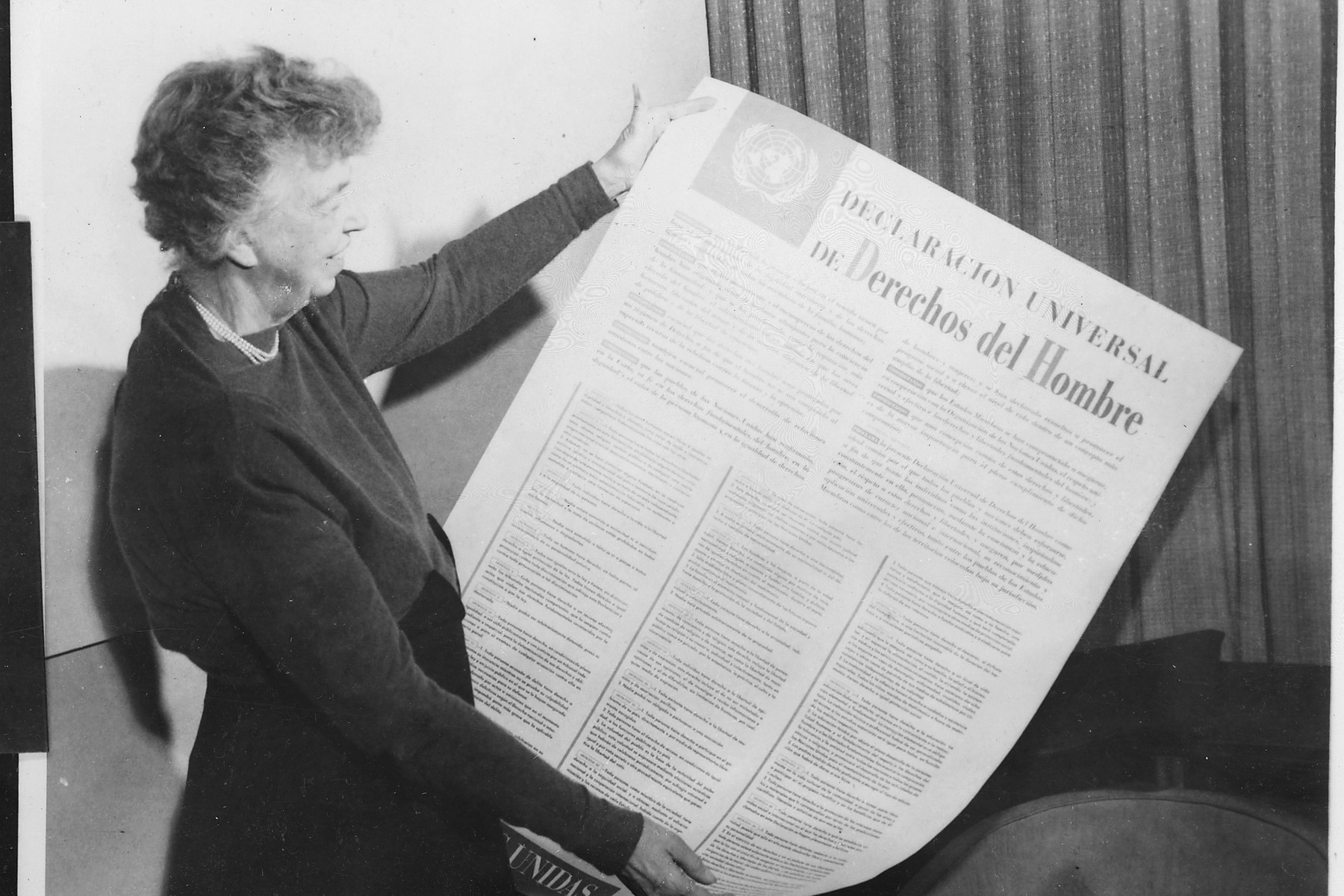
In the war's aftermath, the newly formed United Nations tasked a drafting committee, chaired by Eleanor Roosevelt, with producing a statement of rights that could command broad international agreement across sharply different political, religious, and cultural systems. The resulting Universal Declaration of Human Rights, adopted on 10 December 1948, set out thirty articles covering civil and political rights — including freedom of speech, freedom from torture, and the right to a fair trial — alongside economic and social rights, including the right to education, work, and an adequate standard of living.
Crucially, the Declaration is not a treaty. It creates no binding legal obligations on its own and includes no enforcement body. Its authority rests instead on the fact that it represented, at the time, the broadest international consensus ever achieved on what a floor of human dignity should look like, and it went on to directly inform binding international treaties that followed — including the International Covenant on Civil and Political Rights and the International Covenant on Economic, Social and Cultural Rights, both adopted in 1966.
THE LONGER LEGACY
The Declaration's language has been incorporated, in whole or in part, into the constitutions of numerous nations founded or reformed since 1948, and it underpins the work of international courts, regional human rights systems, and organizations such as Amnesty International and Human Rights Watch. It has been invoked in support of decolonization movements, anti-apartheid organizing, and countless national human rights campaigns, providing a shared vocabulary that allowed movements in very different political contexts to frame their demands in internationally recognized terms.
WHAT WE STILL MISUNDERSTAND
The Declaration is frequently mischaracterized as binding international law that governments are legally obligated to follow; in fact, it is a non-binding declaration of principles, and its influence operates through moral and political pressure, subsequent binding treaties, and customary international law rather than through direct legal enforcement of the document itself. It's also a mistake to treat it as a fully settled, universally embraced consensus — from its drafting onward, some nations and blocs have contested aspects of its framing, particularly around the balance between individual rights and collective or state interests, and enforcement of its principles remains highly uneven across the world today. The Declaration set a standard; it did not, and could not by itself, guarantee that the standard would be met.
THE MODERN CONNECTION
Contemporary debates over refugee protections, war crimes accountability, freedom of expression, and economic rights all draw on the framework the Declaration established. When international bodies, journalists, or activists describe a government's actions as a "human rights violation," they are invoking a standard that traces directly back to this 1948 document — even in cases where no court has the power to enforce a remedy.
The Social Rethink
Before the Declaration, there was no widely accepted international standard for what any government owed the people living under it, and what happened inside a nation's borders was broadly treated as beyond outside concern. Afterward, even without a single enforcement mechanism, it became possible to say that a government had violated an internationally recognized human right — a claim that carries real diplomatic, political, and moral weight even when it carries no legal force. The Declaration's lasting achievement was proving that a shared standard, agreed to by consensus rather than imposed by force, could still shape how the world judges the legitimacy of a government's conduct.
If a document with no enforcement power could still reshape global expectations of human dignity, what does that suggest about the relationship between moral consensus and legal power?