Filed under Ideas · Social Rethinks
The Weapon That Wasn't One
For most of history, political power that refused to negotiate was met with force, or it wasn't met at all. Gandhi proposed a third option: organized, disciplined nonviolence that made injustice impossible to look away from.
- Share “The Weapon That Wasn't One” on X
- Share “The Weapon That Wasn't One” on Facebook
- Share “The Weapon That Wasn't One” on LinkedIn
- Share “The Weapon That Wasn't One” on WhatsApp
- Share “The Weapon That Wasn't One” on Telegram
- Share “The Weapon That Wasn't One” on Reddit
- Share “The Weapon That Wasn't One” on Email
OPENING
By the early 20th century, the logic of political resistance seemed straightforward: a government backed by armed force could only be seriously challenged by comparable or greater force. Mohandas Gandhi's development and deployment of organized nonviolent resistance — a philosophy he called satyagraha, often translated as "truth-force" or "soul-force" — rejected that premise entirely. Gandhi argued that disciplined nonviolence was not merely an ethical alternative to armed struggle, but frequently a more effective one, capable of exposing the moral bankruptcy of an unjust system in ways that violence could not. Deployed first in South Africa and then across decades of the Indian independence movement, it became one of the most influential and widely replicated strategies for political change in modern history.
HISTORICAL CONTEXT
Political resistance against colonial rule and entrenched power throughout the 19th and early 20th centuries most commonly took the form of armed rebellion, which colonial and authoritarian governments were typically well equipped to suppress through superior military force. Nonviolent protest existed in various forms — petitions, boycotts, strikes — but was rarely organized into a comprehensive, sustained political strategy explicitly designed to make an unjust system's continuation untenable without directly matching its capacity for violence.
THE TURNING POINT
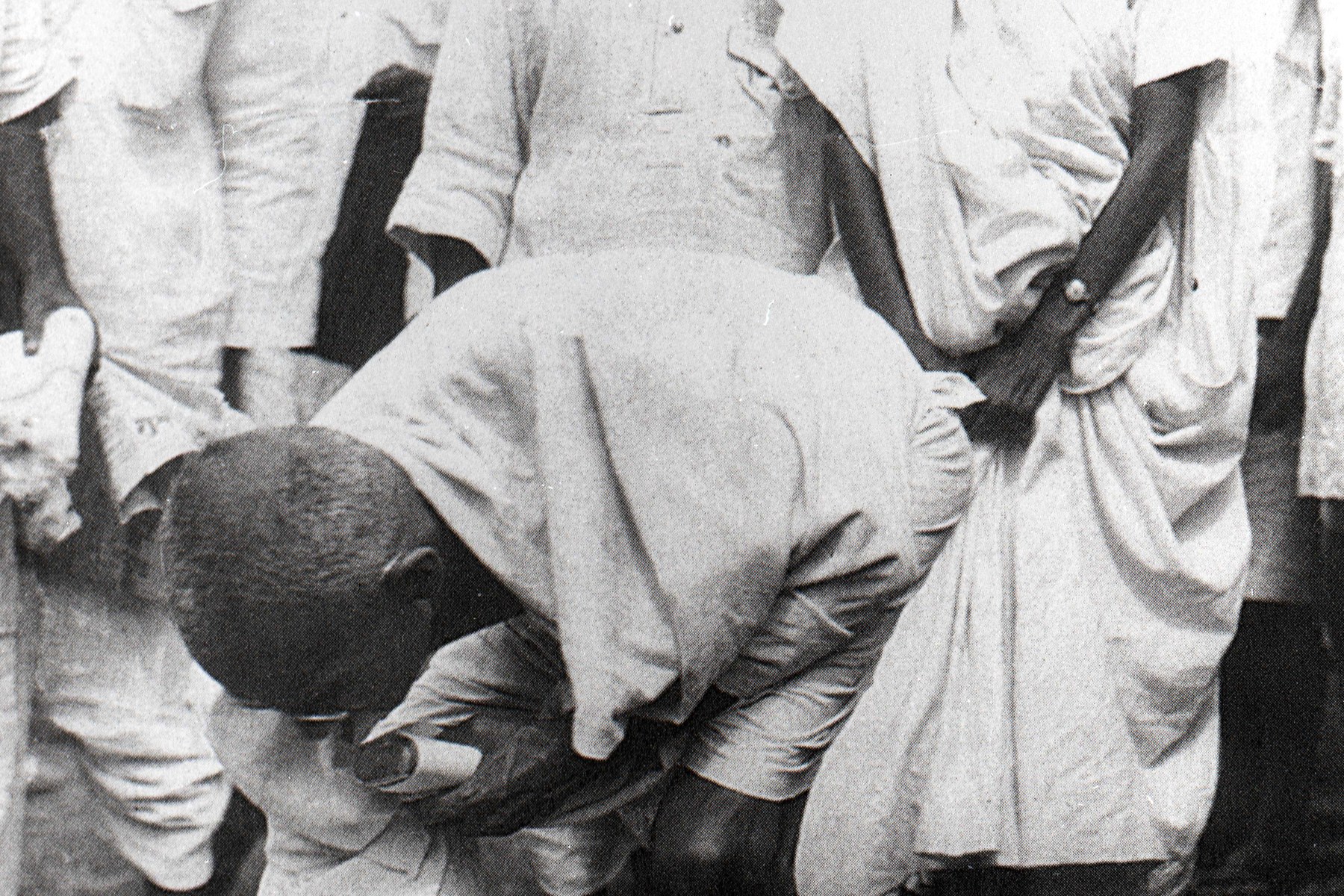
Gandhi first developed and tested satyagraha while working as a lawyer in South Africa, organizing Indian communities there against discriminatory laws between 1893 and 1914. Returning to India, he applied and expanded the strategy across decades of organizing against British colonial rule, most famously in the 1930 Salt March, in which Gandhi and his followers walked roughly 240 miles to the sea to produce salt in defiance of a British colonial monopoly and tax — a deliberately symbolic act of civil disobedience that drew international attention to the independence movement.
Satyagraha combined several elements: strict discipline against retaliatory violence even in the face of brutal suppression, willingness to accept legal consequences and imprisonment for civil disobedience, and a strategic use of media and public visibility to expose the disproportionate force used against nonviolent protesters. This combination proved to have significant strategic as well as moral power — images and accounts of nonviolent Indian protesters facing violent colonial suppression damaged British public support for continued colonial rule both domestically and internationally. India achieved independence in 1947, following decades of organizing in which Gandhi's leadership and philosophy played a central, though not sole, role alongside other independence leaders and movements.
THE LONGER LEGACY
Gandhi's approach became a direct and explicitly acknowledged influence on subsequent nonviolent movements around the world. Martin Luther King Jr. studied Gandhi's writings and methods closely and applied similar principles of disciplined nonviolent civil disobedience during the U.S. Civil Rights Movement. Nonviolent resistance also played a significant role in the anti-apartheid movement in South Africa and in numerous other 20th-century movements for political and civil rights. Academic research on the comparative effectiveness of nonviolent versus violent resistance movements, including widely cited studies published in the 2010s, has since found that nonviolent campaigns have historically succeeded in achieving their stated goals at notably higher rates than violent ones — lending empirical support to what Gandhi had argued on strategic and moral grounds decades earlier.
WHAT WE STILL MISUNDERSTAND
Gandhi's nonviolence is sometimes presented as a purely passive or automatically successful strategy; in practice, satyagraha required extensive organization, discipline, and willingness to endure real physical suffering and imprisonment, and its success in any given campaign depended heavily on specific political and media conditions rather than being guaranteed by nonviolence alone. It's also a mistake to treat Indian independence as the achievement of Gandhi individually — it resulted from decades of organizing by many leaders and movements with sometimes differing strategies and goals, alongside broader geopolitical pressures on Britain following the Second World War. Additionally, Gandhi's own legacy is genuinely contested by historians, including sharp criticism of some of his early writings and positions regarding race and caste, which a historically responsible account should not omit in favor of a simplified, purely heroic narrative.
THE MODERN CONNECTION
Nonviolent civil disobedience remains a widely used strategy in contemporary political movements worldwide, from pro-democracy protests to civil rights and climate activism, frequently citing Gandhi's methods directly as inspiration or precedent. The core strategic insight — that visible, disciplined nonviolence in the face of disproportionate force can shift public and international opinion in ways armed resistance often cannot — continues to inform how modern movements plan and frame their campaigns.
The Social Rethink
Before Gandhi's development of satyagraha as a sustained, organized political strategy, the assumption that entrenched power could only be answered with equal or greater force was rarely challenged as a matter of practical politics. Afterward, disciplined nonviolence became a globally recognized, repeatedly effective method of political resistance, expanding the available toolkit for challenging injustice beyond the binary of armed rebellion or passive acceptance.
If nonviolent resistance has proven, again and again, to be a viable path to political change, why does the assumption that only force can answer force remain so difficult to shake?