People · Social Rethinks
The Handshake That Challenged Fear
In 1987, Princess Diana did something simple in front of the world's cameras. She shook a man's hand. At the time, that simple gesture carried a message millions of people needed to see.
- Share “The Handshake That Challenged Fear” on X
- Share “The Handshake That Challenged Fear” on Facebook
- Share “The Handshake That Challenged Fear” on LinkedIn
- Share “The Handshake That Challenged Fear” on WhatsApp
- Share “The Handshake That Challenged Fear” on Telegram
- Share “The Handshake That Challenged Fear” on Reddit
- Share “The Handshake That Challenged Fear” on Email
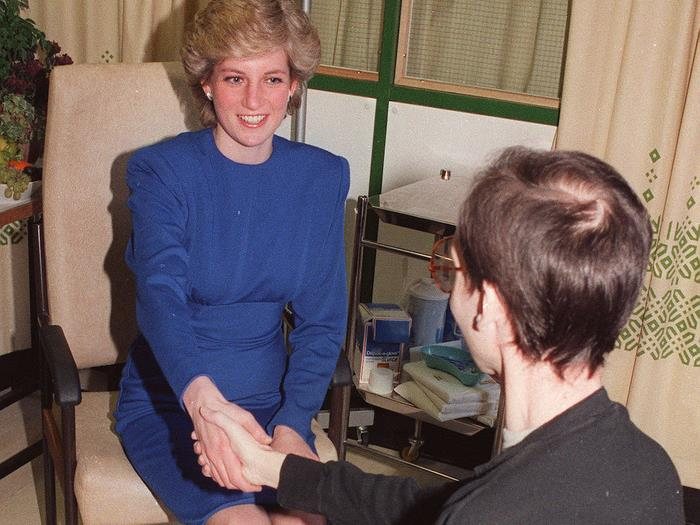
On April 9, 1987, Princess Diana walked into a hospital in London.
She was there to open the Broderip Ward at Middlesex Hospital, one of the first dedicated units in the United Kingdom for people living with HIV and AIDS.
Cameras were waiting.
So were patients.
At the time, fear surrounded HIV.
Many people did not understand how the virus was transmitted.
Some believed they could become infected through ordinary contact.
People living with HIV were often avoided.
Isolated.
Feared.
Then Diana reached out her hand.
She shook hands with a patient.
She was not wearing gloves.
The gesture lasted seconds.
But the photograph travelled around the world.
Sometimes, one simple action can challenge a very complicated fear.
A world afraid of a disease it did not understand
By the 1980s, HIV and AIDS had become one of the world's most frightening public health crises.
But fear was made worse by misinformation.
Scientists were still learning about the virus.
Public understanding was limited.
Rumours spread quickly.
People living with HIV and AIDS faced discrimination in their homes, workplaces and communities.
Many were afraid to tell others about their diagnosis.
Some people believed they could catch HIV through everyday contact.
A handshake.
A hug.
Sharing a space.
These fears were wrong.
But fear does not always need facts to survive.
Sometimes, fear grows fastest where understanding is weakest.
Diana knew what the cameras could do
Princess Diana was one of the most photographed people in the world.
Every movement she made could become international news.
That made her visit different from an ordinary hospital visit.
She understood that.
On April 9, 1987, Diana opened the Broderip Ward at Middlesex Hospital in London.
The ward had been created specifically to care for people with HIV.
During her visit, she shook hands with patients without wearing gloves.
The image became one of the defining photographs of her public life.
The message was simple.
You cannot get HIV by shaking someone's hand.
But the deeper message was even more important.
People living with HIV were still people.
Why the handshake mattered
The science mattered.
Doctors.
Researchers.
Public health campaigns.
Activists.
And people living with HIV were all essential in fighting the epidemic and challenging misinformation.
Princess Diana was not a scientist.
She did not discover a treatment.
She did not create HIV medicine.
She did not lead the global response to AIDS.
Her power was different.
She could make people look.
And then make them think.
When one of the most famous women in the world touched someone others were afraid to touch, she challenged a social message that had become deeply powerful:
Stay away.
Diana's gesture said the opposite.
Come closer.
The stigma was about more than health
HIV and AIDS were never treated as only medical issues.
The crisis became connected to fear about sexuality.
Fear about homosexuality.
Fear about drug use.
Fear about death.
And fear about people considered different.
This made the stigma even more destructive.
Many people living with HIV were already facing prejudice before they became ill.
The disease added another layer of isolation.
That is why compassion became political.
Holding someone's hand was not just a private gesture.
In 1987, it could become a public statement.
One photograph cannot change everything
It is important not to turn this story into a myth.
Princess Diana did not end HIV stigma with one handshake.
Stigma continued.
Discrimination continued.
People continued to die.
And activists, doctors, researchers, charities and people living with HIV continued fighting for treatment, dignity and understanding.
But symbols matter.
Images matter.
And sometimes a single image can make millions of people question something they had accepted.
Diana's handshake did exactly that.
It helped bring a human face to a crisis that was often discussed through fear.
She kept showing up
The 1987 handshake was not a one-time performance.
Diana continued supporting people and organisations affected by HIV and AIDS.
She became a patron of the National AIDS Trust.
She visited hospitals.
She met people living with HIV.
And she continued making physical contact with people at a time when many others remained afraid.
Her connection with Mildmay Hospital in London became particularly significant.
Between 1989 and 1997, Diana visited the hospital many times, including visits away from the cameras.
She sat with patients.
She talked with them.
She held their hands.
Her work showed that the 1987 photograph was part of a longer commitment.
What Diana understood
Princess Diana understood something that statistics cannot always communicate.
People can become afraid of an idea.
A disease.
A group.
A number.
But it becomes harder to fear someone when you see their humanity.
A diagnosis can create distance.
A human connection can reduce it.
That was the power of the handshake.
Diana did not need a speech.
She did not need to explain complex medical science.
She showed people what ordinary human contact looked like.
And millions of people watched.
The old normal
In the 1980s, many people living with HIV faced fear and isolation.
Misinformation was widespread.
Some people believed ordinary contact could transmit the virus.
Avoidance became normal.
Fear became normal.
Distance became normal.
The challenge
Then Princess Diana did something people could understand immediately.
She reached out.
She touched someone others were afraid to touch.
The message
The gesture did not cure HIV.
It did not end the epidemic.
But it challenged something else.
The idea that fear should decide how we treat another human being.
The change
Over time, public understanding of HIV improved.
Scientific knowledge advanced.
Treatments transformed HIV care.
Activists and organisations continued challenging discrimination.
And attitudes changed.
Not completely.
Not everywhere.
But the conversation changed.
People increasingly understood that HIV could not be transmitted through casual contact such as touching or shaking hands.
What once caused fear became basic public health knowledge.
The Social Rethink
THE OLD NORMAL
Fear and misinformation surrounded HIV.
Many people believed distance was the safest response.
THE QUESTION
What happens when fear makes us stop seeing another person as human?
THE GESTURE
Princess Diana shook hands with a patient with AIDS.
Without gloves.
In front of the world's media.
THE MESSAGE
Compassion does not spread disease.
Misinformation does.
THE NEW NORMAL
Today, we know that HIV is not transmitted through ordinary casual contact.
But the larger lesson remains.
Fear can survive long after the facts have changed.
Diana's real influence
Princess Diana is often remembered through images.
The wedding dress.
The royal family.
Her sons.
Her humanitarian work.
Her death.
But some of her most important moments involved something much smaller.
A hand.
A hug.
A conversation.
Physical contact with someone society had decided to fear.
This was not complicated.
That was exactly why it worked.
Sometimes the most powerful challenge to prejudice is refusing to behave as if prejudice is normal.
The bigger question
Diana's story was about HIV.
But the idea behind it belongs to almost every form of social change.
Societies create distance.
Between:
Us and them.
Healthy and sick.
Normal and different.
Accepted and rejected.
Safe and dangerous.
Often, those divisions begin with fear.
And fear can make people accept behaviour they would otherwise recognise as cruel.
History shows us this again and again.
First, someone becomes different.
Then different becomes dangerous.
Then dangerous becomes someone to avoid.
And eventually, society has to ask itself:
When did fear become more important than humanity?
The Rethink
THE OLD NORMAL
People living with HIV were often treated as dangerous.
THE FEAR
Misinformation made ordinary human contact seem frightening.
THE GESTURE
Princess Diana reached out and shook a patient's hand.
THE CHANGE
The image challenged public fear and helped humanise people living with HIV.
THE NEW NORMAL
The science is now clear.
HIV cannot be transmitted through a handshake, a hug or ordinary social contact.
The question for today
Princess Diana's handshake is remembered because it was simple.
But simplicity can reveal something important.
She did not ask the world to agree with her.
She did not tell millions of people what to think.
She showed them another way to behave.
That raises a question for all of us.
What are we afraid of today that we might understand differently if we simply came closer?
Princess Diana did not change the world with a speech that day.
She changed the conversation with a gesture.
Sometimes, the simplest act can ask the biggest question:
Why are we afraid to treat each other like human beings?