Filed under Stories · Social Rethinks
The World Wide Web
The Decision That Connected Humanity
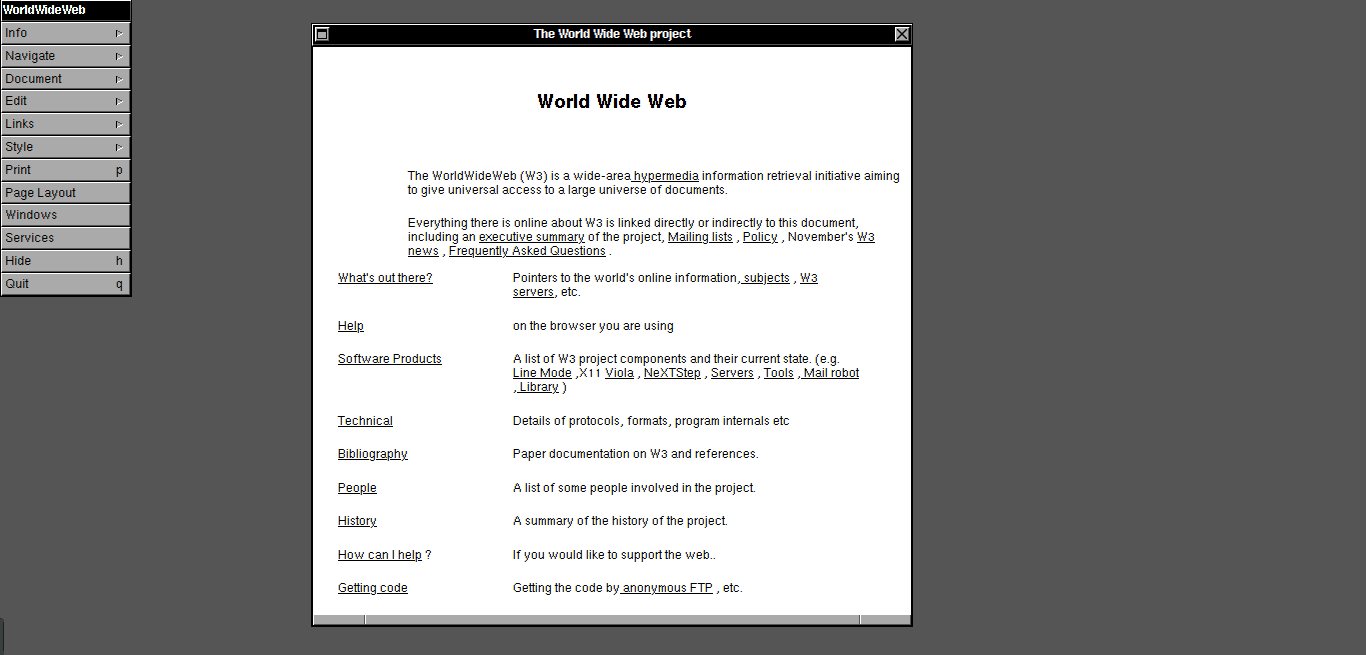
In 1989, Tim Berners-Lee was working at CERN, the European particle physics laboratory. Scientists from different institutions needed a better way to share information. Berners-Lee proposed a system that combined networking with hypertext: documents could be connected through links and accessed through a common information system.
The World Wide Web was not the internet. The internet already existed as a network of networks. The Web was a new way of organising and navigating information on that infrastructure.
By the end of 1990, the first Web server, browser and website were operating at CERN. Berners-Lee and collaborators, including Robert Cailliau, helped develop and promote the system. Other contributors were essential as browsers and servers became available on more computers.
The technology became historically significant because of an institutional decision as much as a technical one. On 30 April 1993, CERN placed the Web software in the public domain. The organisation later released it under an open licence. The choice helped prevent the Web from becoming a proprietary system controlled by one company.
The consequences were enormous. Publishing no longer required ownership of a printing press, television station or newspaper. Eventually, individuals could create websites, publish ideas, start businesses and communicate with global audiences at relatively low cost.
This changed power, but not in one direction. The Web decentralised publication while also creating new platforms and concentrations of influence. It expanded access to information while creating new forms of misinformation. It connected people while enabling surveillance and manipulation.
The Web is therefore one of the clearest examples of a technology that democratised capability without automatically democratising outcomes.
The Social Rethink
THE OLD NORMAL: Publishing and large-scale distribution required expensive institutions.
THE IDEA: Information could be linked and shared through open standards.
THE DECISION: CERN released the core Web software for broad public use.
THE CHANGE: Global publishing became accessible to billions of people.
THE CONSEQUENCE: Society gained unprecedented communication and unprecedented information problems.
The early Web carried an optimistic promise: a global library where knowledge could be connected rather than locked away. That promise remains partly true.
But the modern Web is also an advertising system, a political battleground and a source of enormous commercial power. Algorithms now influence what people see. Platforms can shape public debate. Artificial intelligence is beginning to change how information is created.
That makes the original decision at CERN even more interesting. The Web was built around openness. The modern question is whether openness alone can protect a public information space from exploitation.
The Web changed what it means to have a voice.
The question now is whether being able to speak guarantees being heard—or understood.
The Longer Legacy
The Web's open architecture encouraged experimentation. New websites could be created without asking a central publisher for permission. Search engines and social platforms later reorganised how people discovered information.
What We Still Misunderstand
The Web and the internet are related but not identical. The internet provides the underlying network infrastructure. The Web is one service built on it.
The Modern Connection
AI may represent another information shift. If the Web made publishing easier, generative systems may make producing content easier. That makes verification, provenance and media literacy even more important. The lesson of the Web is not simply 'connect everyone.' It is 'build systems worthy of the connections they create.'