Filed under Stories · Social Rethinks
The Moon Landing
The Moment Humanity Looked Back at Earth
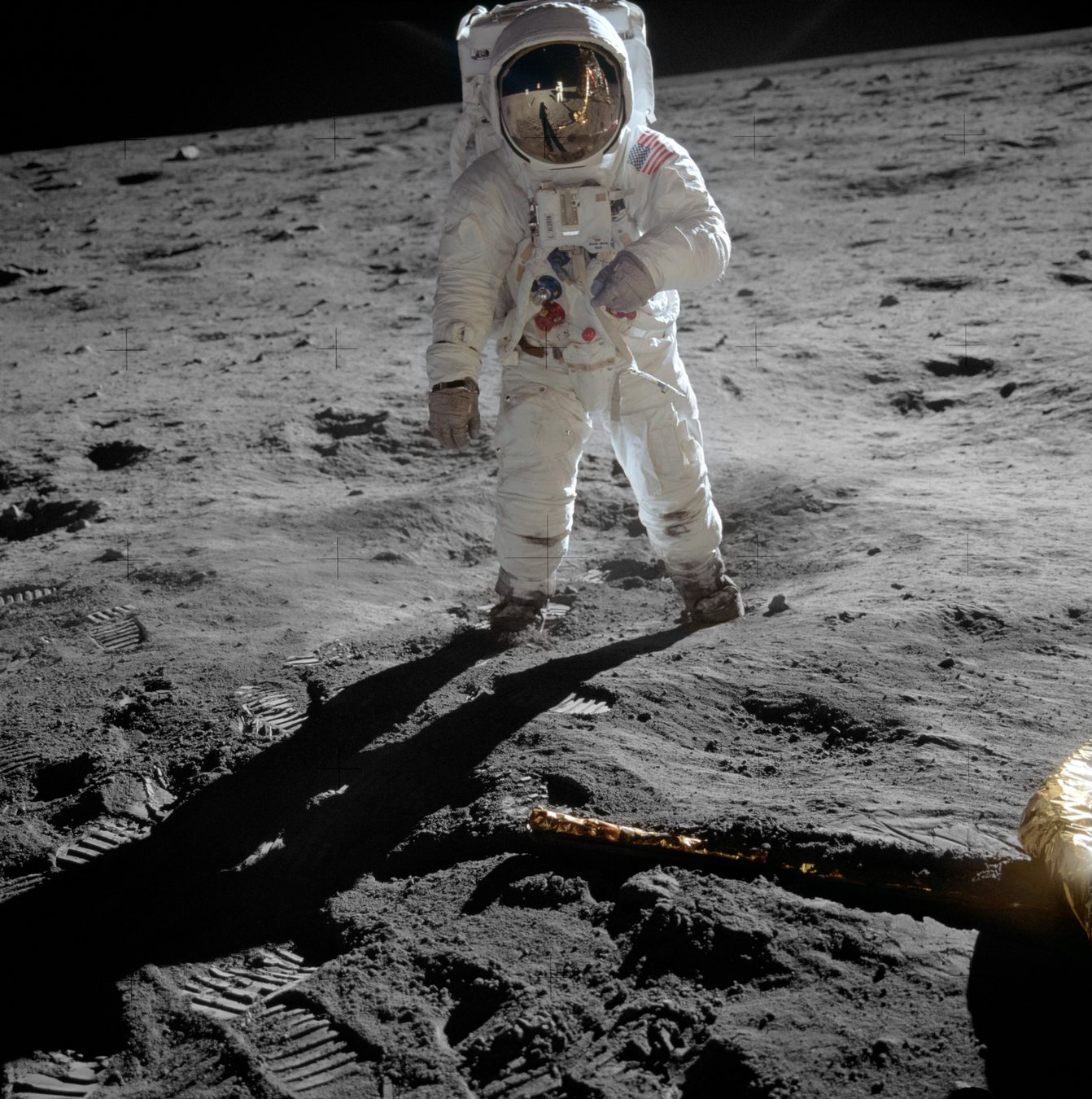
On 20 July 1969, Apollo 11's lunar module, Eagle, landed on the Moon. Neil Armstrong and Buzz Aldrin became the first humans to walk on its surface. Michael Collins remained in lunar orbit inside the command module.
The achievement was the result of an enormous technical programme, not a simple triumph of individual astronauts. NASA, contractors, engineers, scientists and support teams worked across the United States. The mission also existed inside the political competition of the Cold War, following President John F. Kennedy's 1961 goal of landing a person on the Moon and returning them safely before the end of the decade.
Apollo 11 succeeded, but its significance was larger than a flag or a footprint. Humans had left their home world and stood on another celestial body. For the first time, the idea of travelling beyond Earth became a demonstrated reality.
The mission also changed how people saw Earth. Images from the space age showed a planet without visible political borders, suspended in darkness. The famous Earthrise photograph was taken during Apollo 8 rather than Apollo 11, but together the Apollo missions strengthened a new visual understanding of Earth as finite, shared and vulnerable.
The connection between Apollo and every modern technology is sometimes exaggerated. Space exploration did not simply invent the digital age. But the programme pushed advances in systems engineering, computing, materials and complex project management. Its wider influence was real precisely because the effort was so demanding.
Apollo also raises questions about priorities. The Moon landing was enormously expensive. Critics asked whether those resources should have been spent on problems on Earth. Supporters argued that exploration and technological investment could generate broader benefits. Both questions remain relevant whenever societies decide how to invest public resources.
The Social Rethink
THE OLD NORMAL: Earth was humanity's unquestioned physical boundary.
THE CHALLENGE: Could humans travel to another world and return safely?
THE ACHIEVEMENT: Apollo 11 demonstrated that crewed lunar exploration was possible.
THE NEW PERSPECTIVE: Earth could be seen as a single planet from outside.
THE LEGACY: Exploration became a question of capability, responsibility and purpose.
Perhaps the deepest change was psychological. For most of history, the sky had been above humanity. Apollo made it a destination.
But leaving Earth also made Earth more visible. Space exploration created some of the clearest images of our planetary limits.
The Moon landing therefore produced two opposite impulses: look outward and look back.
The question for today is whether technological ambition and planetary responsibility must compete. Apollo suggests another possibility. A civilisation capable of solving difficult problems can choose where to direct that capability.
Humanity reached the Moon. The harder question may be what we choose to become while standing on Earth.
The Longer Legacy
Apollo was also an extraordinary exercise in coordination. A lunar mission required navigation, communications, computing, life-support systems and teams capable of making decisions under pressure. The programme demonstrated what large institutions can achieve when a goal is specific and resources are sustained.
What We Still Misunderstand
Not every technology used today came directly from NASA or Apollo. 'Spinoff' stories are often simplified. The more defensible legacy is broader: space programmes accelerated research, engineering and organisational capability in multiple fields.
The Modern Connection
Private companies and national agencies are now pursuing new lunar missions. The central question has returned in a different form. Exploration is no longer only about proving that something can be done. It is increasingly about deciding why, for whom and under what rules.