People · Social Rethinks
Mother Teresa When Compassion Became a Global Language
She was a small woman in a simple white sari who became one of the most recognisable people on Earth. Mother Teresa changed the way millions of people thought about service, poverty and the responsibility to care for someone they did not know.
- Share “Mother Teresa: When Compassion Became a Global Language” on X
- Share “Mother Teresa: When Compassion Became a Global Language” on Facebook
- Share “Mother Teresa: When Compassion Became a Global Language” on LinkedIn
- Share “Mother Teresa: When Compassion Became a Global Language” on WhatsApp
- Share “Mother Teresa: When Compassion Became a Global Language” on Telegram
- Share “Mother Teresa: When Compassion Became a Global Language” on Reddit
- Share “Mother Teresa: When Compassion Became a Global Language” on Email
For much of the twentieth century, global influence belonged to a familiar group of people.
Presidents.
Generals.
Business leaders.
Scientists.
Political revolutionaries.
Then there was Mother Teresa.
She commanded no army.
She held no elected office.
She led no country.
Yet by the time she died in 1997, she had become one of the most recognised human beings in the world.
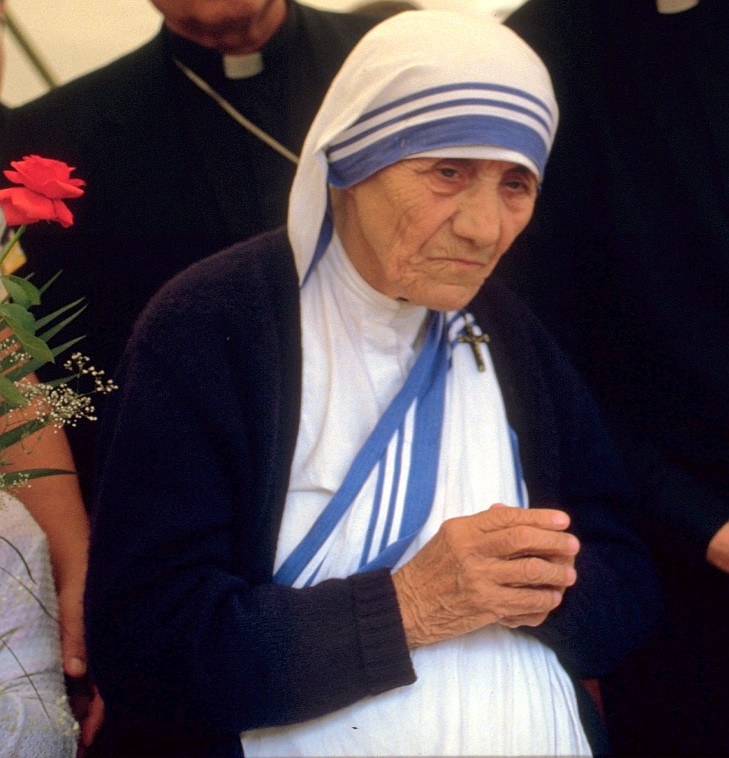
Her image was simple: a woman in a white sari with a blue border, walking through the streets of Calcutta.
But the idea behind that image was much larger.
Mother Teresa made a simple argument through her life:
Human dignity should not depend on whether someone is useful, wealthy, healthy or known.
For millions of people, that message changed the meaning of service.
For others, her methods and beliefs raised serious questions.
Both realities belong to her story.
And that is what makes Mother Teresa more interesting than the simplified image that history often presents.
Before Mother Teresa, Charity Had a Different Image
Helping people in need was not a new idea when Mother Teresa began her work.
Religious organisations had cared for the poor for centuries.
Hospitals.
Orphanages.
Religious missions.
Charities.
Community organisations.
All existed long before her.
But Mother Teresa helped create a different global image of humanitarian service.
She did not become famous for building a large political institution.
She became famous because she appeared to go where many people did not want to go.
To people dying on the streets.
To people abandoned by families.
To those living with serious illness.
To people society often preferred not to see.
Her message was direct.
Do not look away.
The poor were not an abstract problem.
They were individual human beings.
And they deserved to be treated as such.
That idea would eventually turn a Catholic nun from the Balkans into a global symbol.
Agnes Became Teresa
Mother Teresa was born Agnes Gonxha Bojaxhiu on August 26, 1910, in Skopje, then part of the Ottoman Empire and now the capital of North Macedonia.
Her family was of Albanian descent.
At the age of eighteen, she left home and joined the Sisters of Loreto, an Irish Catholic religious order with missions in India.
She travelled first to Ireland and later to India.
In 1931, she took her initial vows and became Sister Teresa.
For many years, she taught at St. Mary's School in Calcutta.
Her life was structured.
She was a teacher.
A nun.
A member of a religious community.
But outside the walls of the school was another world.
Poverty.
Illness.
Homelessness.
People dying without medical care or family support.
The contrast became impossible for her to ignore.
The Call Within a Call
In 1946, Mother Teresa experienced what she later described as a "call within a call."
She believed she was being called to leave the relative security of the convent and dedicate her life to serving the poorest people in Calcutta.
The decision would change everything.
In 1948, after receiving permission, she left the Loreto community and began working directly among people living in poverty.
She wore a simple white sari with a blue border.
She began with very little.
An open-air school.
Visits to families.
Basic care.
Direct contact with people who had often been ignored.
She was soon joined by others.
In 1950, the Missionaries of Charity was officially established.
Its members would take the traditional religious vows of poverty, chastity and obedience, along with a fourth commitment: wholehearted and free service to the poorest of the poor.
This was the beginning of something much larger than one woman's personal mission.
A Small Mission Became a Global Movement
The Missionaries of Charity expanded.
Homes and services were established for people including those who were homeless, seriously ill, orphaned or otherwise abandoned.
The organisation eventually expanded beyond India.
Mother Teresa became internationally known.
Then came television.
Photography.
Global media.
Her face became familiar across continents.
But her public image was unusually simple.
She did not represent wealth.
She did not represent political power.
She represented direct service.
This was part of her influence.
Mother Teresa made compassion visible.
And visibility matters.
Many people know poverty exists.
But knowing something exists is not the same as feeling responsible for it.
Mother Teresa's public presence helped turn the suffering of people living in extreme poverty into something millions of people could no longer completely ignore.
The Nobel Prize
In 1979, Mother Teresa received the Nobel Peace Prize for her work in bringing help to suffering humanity.
By then, her name had become almost synonymous with charitable service.
The Nobel Prize made her influence even greater.
She had become a global moral figure.
But her message remained remarkably simple.
Start close to home.
See the individual.
Do something.
Her philosophy was not based on waiting for governments or international institutions to solve every problem before acting.
It began with personal responsibility.
What can you do for the person in front of you?
That question travelled around the world.
And it remains one of the reasons her legacy continues.
Mother Teresa died in Calcutta on September 5, 1997.
She was later canonised by the Catholic Church and declared a saint by Pope Francis in 2016.
The Symbol Was More Powerful Than the Person
There is a danger in discussing Mother Teresa.
It is easy to turn her into a symbol.
A symbol of kindness.
A symbol of religion.
A symbol of charity.
But symbols are simpler than people.
Mother Teresa was also a deeply religious person with strong beliefs.
She opposed abortion and held views consistent with conservative Catholic teaching.
Her work was driven by faith.
Her understanding of suffering was religious.
Her idea of charity was not simply secular humanitarianism.
This matters.
To understand Mother Teresa honestly, we must understand that she was not trying to become a modern political activist.
She was a Catholic missionary.
Her mission was spiritual and practical at the same time.
For some people, this made her work more meaningful.
For others, it created serious disagreements.
The global symbol and the real person were not always the same.
What We Still Misunderstand
Mother Teresa Was Not Beyond Criticism
Mother Teresa's legacy has been the subject of serious criticism.
Former volunteers, writers, journalists and medical professionals have raised concerns about conditions in some Missionaries of Charity homes.
Criticisms have included allegations regarding hygiene, medical standards, pain management and the use of medically trained personnel.
Her critics have also questioned some of her political associations and her approach to suffering and poverty.
These criticisms should not simply be ignored because Mother Teresa became famous or was later declared a saint.
Nor should they automatically erase everything she did.
History is often more complicated than the choice between hero and villain.
Mother Teresa inspired millions of people.
Her organisation provided services to people in extreme need.
She changed the public image of charitable service.
And legitimate questions have been raised about aspects of care associated with some of her institutions.
All of these things can be true.
Rethinking a person means being willing to see the whole story.
The Social Rethink
THE OLD NORMAL
Poverty was often something people saw from a distance.
The poor could become statistics.
Problems for governments.
Images in newspapers.
Someone else's responsibility.
THE QUESTION
What responsibility do we have toward a person who has nothing?
Does a person's value depend on wealth, health or social status?
THE BREAKTHROUGH
Mother Teresa made direct service to the "poorest of the poor" the centre of a global movement.
Her work made individual compassion internationally visible.
THE CHANGE
Millions of people encountered a new image of humanitarian service.
One person could begin with limited resources and inspire a worldwide network.
Charity became not only an institutional responsibility, but a personal question.
THE NEW NORMAL
The idea that ordinary individuals could contribute directly to helping strangers became more visible across global culture.
Mother Teresa became evidence that moral influence did not require political power.
Compassion Is Not Passive
Perhaps Mother Teresa's greatest influence was not that she taught people to feel sorry for others.
It was that she made compassion look active.
Feeling concern was not enough.
Someone had to go.
Someone had to wash.
Someone had to feed.
Someone had to sit beside the person who was alone.
This changed the language of charity.
Compassion became action.
That idea has influenced:
- Religious organisations
- Charities
- Volunteers
- Humanitarian movements
- Community organisations
- Individuals around the world
The methods may differ.
The beliefs may differ.
But the central question remains powerful.
What does compassion require us to do?
The Modern Connection
Today, we live in a world with unprecedented access to information.
We can see almost every crisis.
War.
Poverty.
Natural disasters.
Homelessness.
Disease.
Human suffering.
Through our phones, we can know about tragedies happening thousands of kilometres away within seconds.
But there is a problem.
Seeing more does not always mean caring more.
In fact, constant exposure can produce distance.
We become overwhelmed.
Another crisis.
Another image.
Another statistic.
Another disaster.
Mother Teresa's story offers a different approach.
Do not try to emotionally carry the entire world at once.
Start with the person you can actually see.
The neighbour.
The stranger.
The person nobody else is helping.
This idea remains powerful precisely because modern problems often feel too large.
We may not be able to solve everything.
But we can decide not to do nothing.
The Deeper Legacy
Mother Teresa did not invent compassion.
She did something different.
She gave compassion a globally recognisable face.
That matters.
Society often changes when an abstract idea becomes human.
Civil rights became Rosa Parks refusing to give up her seat.
Political representation became Barack Obama standing before the White House.
Humanitarian service became Mother Teresa walking through Calcutta in a white sari.
These individuals did not create entire movements alone.
But they became symbols that helped people understand a larger change.
Mother Teresa's life also demonstrates something else.
Global influence does not always begin with global ambition.
Sometimes it begins with a small decision.
To leave a comfortable environment.
To pay attention.
To help.
And to continue.
The Rethink
Mother Teresa changed the question of who could influence the world.
She had no army.
No political office.
No corporation.
No technology company.
No election campaign.
Her influence came from something more difficult to measure.
Moral attention.
She looked at people society had often stopped looking at.
And she asked others to do the same.
That was her Social Rethink.
Not everyone agreed with her beliefs.
Not every aspect of her legacy is beyond criticism.
But the larger transformation remains.
She helped millions of people reconsider the idea that significance belongs only to powerful people.
Sometimes influence begins with someone doing something very small.
For someone nobody else knows.
The question Mother Teresa leaves behind is not:
Can I save the world?
It may be something more realistic.
And more demanding.
Who is in front of me that the world has taught me not to see?
- Mother Teresa
- People
- Social Rethinks
- Humanitarianism
- Compassion
- History
- India
- Missionaries of Charity
- Nobel Peace Prize
- Leadership