Filed under Stories · Social Rethinks
The Discovery of X-Rays
The Day Humanity Learned to See the Invisible
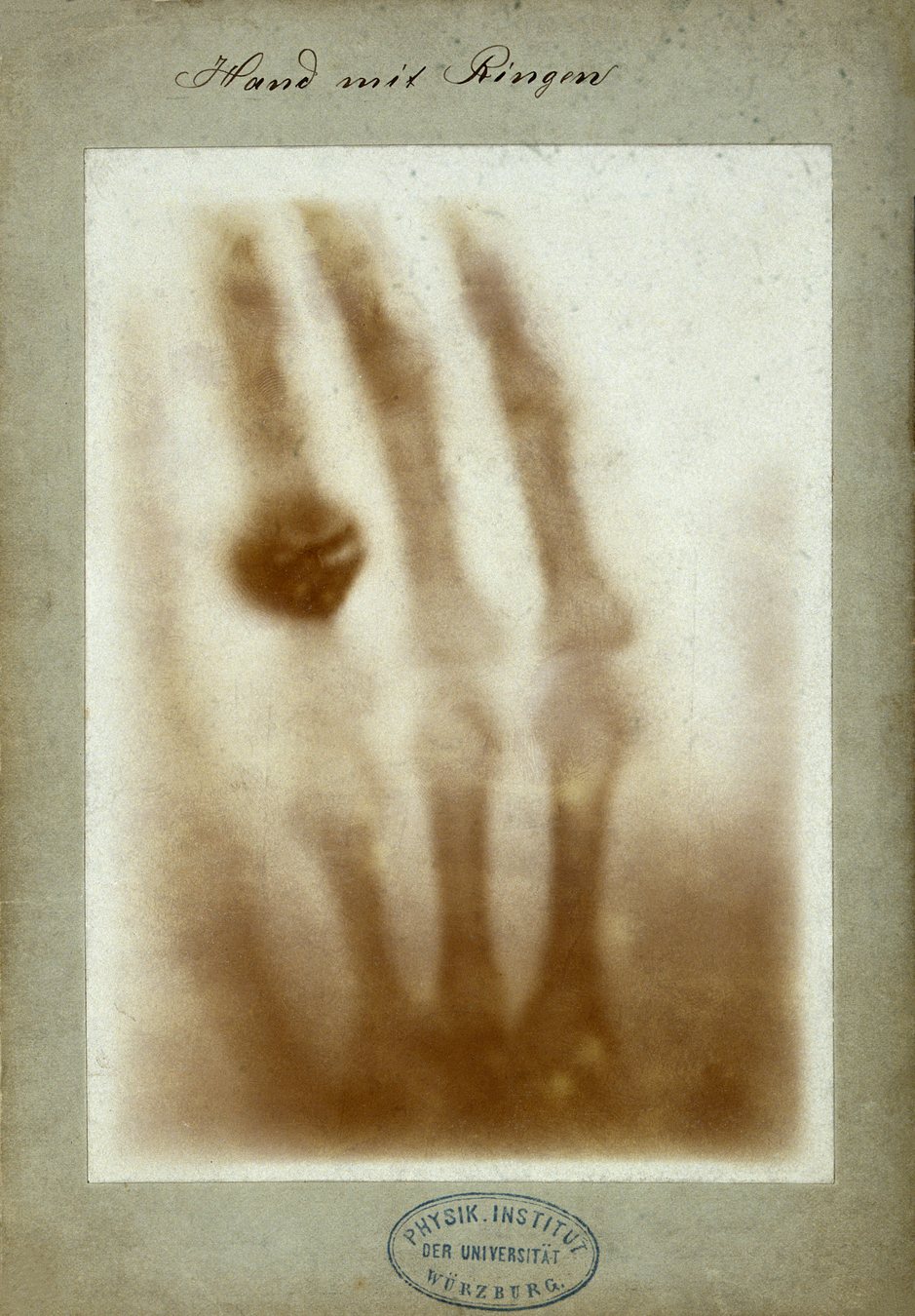
On 8 November 1895, Wilhelm Conrad Röntgen noticed something strange in his laboratory in Würzburg. He was experimenting with cathode rays when a fluorescent screen nearby began to glow. The apparatus was covered. Whatever was causing the effect appeared able to pass through material that blocked ordinary light.
Röntgen investigated in secret for weeks. He tested different materials and discovered that the mysterious radiation could pass through some substances while being absorbed by others. When he photographed his wife's hand, the result showed bones and a ring inside a living body. The image was astonishing because it made the invisible visible.
He called the discovery X-rays, using X as the mathematical symbol for something unknown. The name remained.
The importance of X-rays was immediate. Before medical imaging, doctors often had to infer internal injuries from symptoms, physical examination or invasive procedures. X-rays created a new kind of evidence. A fracture could be seen. A foreign object could be located. The interior of the body became available to observation without opening it.
Yet the early history also contained danger. Scientists and doctors did not initially understand the risks of ionising radiation. Some early users suffered burns and long-term injuries. Protection standards developed gradually. The story is therefore also a lesson in scientific humility: a discovery can be revolutionary before society fully understands its consequences.
X-rays rapidly entered medicine, industry and research. They helped transform diagnosis, but they also changed the philosophy of medicine. The body was no longer understood only through what a patient felt or what a physician could touch. Instruments could reveal structures hidden from ordinary senses.
The discovery did not directly create every modern imaging technology. Ultrasound, magnetic resonance imaging and computed tomography emerged through different scientific and technical paths. But X-rays established a powerful idea: technology could extend human perception and reveal realities that eyes alone could never see.
That idea changed more than medicine. It altered how people understood the limits of observation. Human senses had once seemed like the natural boundary of knowledge. X-rays demonstrated that reality could contain useful information beyond direct perception.
The image of Röntgen's wife's hand became one of the defining scientific images of the modern age. It represented both wonder and unease. What else might exist around us that we cannot see?
The Social Rethink
THE OLD NORMAL: What could not be seen directly was difficult to investigate.
THE DISCOVERY: X-rays revealed structures inside opaque objects and living bodies.
THE CONSEQUENCE: Medicine gained a new way to diagnose injury and disease.
THE WARNING: Early users discovered that powerful technologies can also cause harm.
THE NEW NORMAL: Seeing is no longer limited to the human eye.
The modern world is built on instruments that translate invisible signals into information. Medical scans, satellite sensors and scientific detectors all depend on the same broader principle: human knowledge expands when we build tools that reveal what nature does not show us directly.
Röntgen's discovery began with a glow on a screen. Its larger legacy was a rethink of what it means to see.
The question remains: how much of reality are we still missing simply because we have not yet built the right instrument?
The Longer Legacy
The first reaction to X-rays combined excitement with confusion. Newspapers and public demonstrations helped spread news of the discovery. Scientists rapidly repeated experiments. Doctors saw practical possibilities almost immediately.
But medicine had to learn how to use the new power responsibly. Better imaging required better equipment, training and safety standards. The development of radiology became a professional and scientific field.
What We Still Misunderstand
X-rays are often grouped together with every modern scanning technology. In reality, modern imaging developed through several distinct scientific histories. MRI uses magnetic fields and radio waves. Ultrasound uses sound waves. CT uses X-rays combined with computer processing. Their common purpose does not mean they share one direct invention story.
The Modern Connection
Artificial intelligence is now extending perception again, helping scientists analyse images and detect patterns. The lesson from X-rays remains useful: new ways of seeing should improve human judgment, not replace careful thinking. An instrument can produce data. Society still has to interpret it responsibly.